

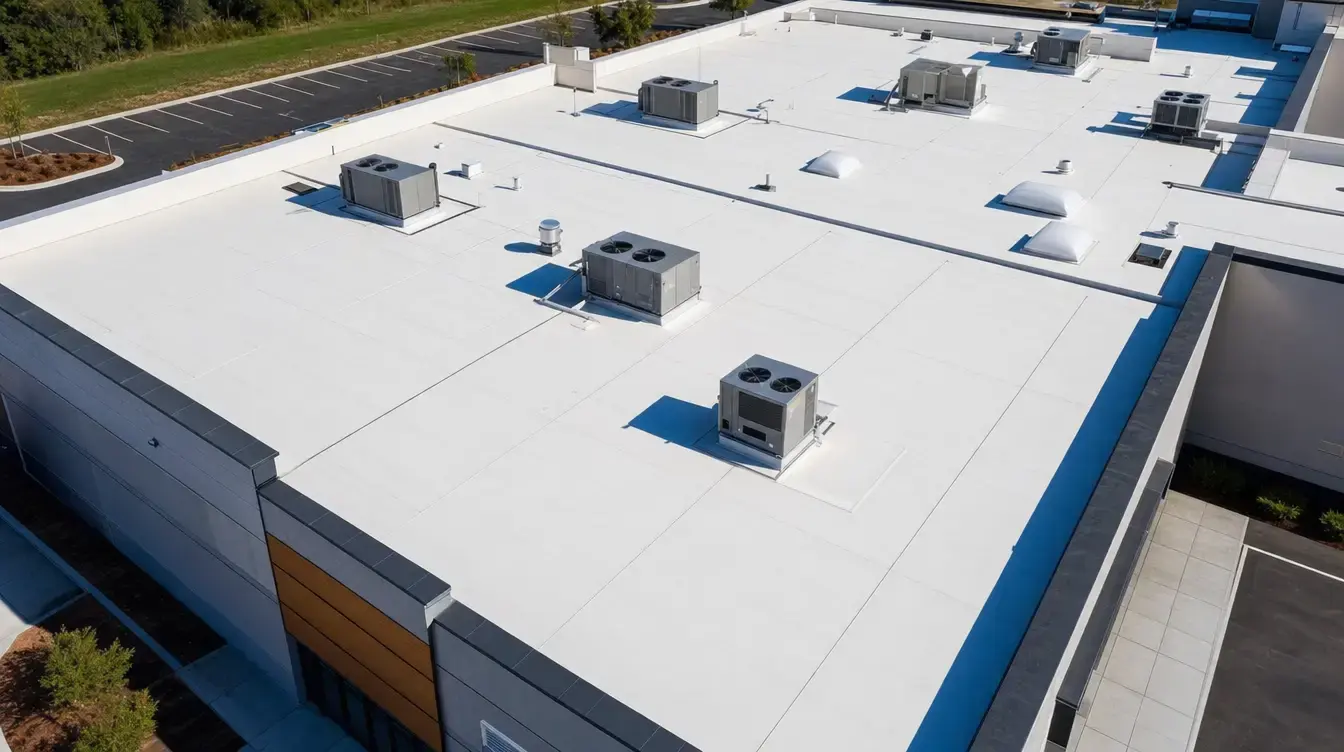
The three main commercial flat roof membranes are TPO, PVC, and EPDM, and each suits a different building and budget. TPO is the popular middle ground, PVC is the premium pick for restaurants and chemical exposure, and EPDM is a proven, lower cost rubber roof. If your existing membrane is still sound, a silicone restoration coating can add years without a full tear off. Here is how to decide.
First, what a commercial flat roof has to do
A low-slope commercial roof has a harder job than a steep residential roof. Water drains slowly instead of running off, so the membrane has to be watertight across the whole surface, every seam, and every penetration. It also sits fully exposed to sun, heat, and ponding. The right system depends on your building, your rooftop equipment, your budget, and how long you plan to own the property.
CER Roofing installs all three major single ply membranes (TPO, PVC, and EPDM) plus silicone restoration coatings, so we can recommend the right fit instead of pushing the one system we happen to sell.
TPO roofing
TPO (thermoplastic polyolefin) is the most widely installed commercial flat roof membrane today, and for good reason. It is a single ply sheet with heat-welded seams that fuse into one continuous surface. The seams are a major strength, because a welded seam is far more reliable than a glued or taped one.
TPO pros
- ▸Bright white reflective surface that bounces heat and helps lower cooling bills in our hot summers.
- ▸Strong heat-welded seams that resist leaks.
- ▸Good value, usually less expensive than PVC.
- ▸Resists most punctures and tears when installed at a proper thickness.
TPO cons
- ▸Quality varies between manufacturers, so the brand and thickness you choose matter.
- ▸Not the best choice for roofs exposed to grease or chemicals, where PVC holds up better.
A quality TPO roof commonly lasts around 20 to 30 years when it is installed well and maintained. For a typical retail, office, or warehouse building, TPO is often the smartest balance of cost and performance.
PVC roofing
PVC (polyvinyl chloride) is also a heat-welded single ply membrane, and it is the premium step up from TPO. Its standout trait is chemical and grease resistance, which is why you see it on restaurants and any building venting oils or fumes onto the roof.
PVC pros
- ▸Excellent resistance to grease, oils, and chemicals, ideal for restaurant kitchens and certain industrial buildings.
- ▸Strong heat-welded seams, like TPO.
- ▸Reflective and energy efficient.
- ▸Long, dependable service life.
PVC cons
- ▸Higher upfront cost than TPO or EPDM.
- ▸Can become more brittle with age in some conditions.
If your building puts grease or chemicals on the roof, PVC is usually worth the extra money. For a standard office or warehouse with no chemical exposure, TPO often makes more sense.
EPDM roofing
EPDM (ethylene propylene diene monomer) is a synthetic rubber membrane, and it is the oldest of the three. You will recognize it as the classic black rubber roof. It has decades of real world track record, which counts for a lot.
EPDM pros
- ▸Proven durability with a long history of dependable performance.
- ▸Often the lowest material cost of the three membranes.
- ▸Very flexible, which helps it handle expansion and contraction through temperature swings.
- ▸Simple to repair.
EPDM cons
- ▸The standard black surface absorbs heat instead of reflecting it, which can raise cooling costs (lighter colored EPDM is available at higher cost).
- ▸Seams are typically taped or glued rather than heat-welded, so seam quality depends heavily on careful installation.
EPDM is a solid, budget conscious choice, especially for buildings where a reflective white roof is not a priority. A well installed EPDM roof commonly lasts 20 to 30 years.
Silicone restoration coatings
Not every aging flat roof needs a full tear off. If your existing membrane is still structurally sound and mostly watertight, a silicone restoration coating can be sprayed or rolled over it to seal small leaks, stop ponding water damage, and add a fresh reflective surface. It is a fluid applied layer that cures into a seamless waterproof skin.
When a silicone coating makes sense
- ▸The roof deck and insulation underneath are still dry and in good shape.
- ▸The membrane has surface wear and minor leaks, not widespread failure.
- ▸You want to extend the roof's life and avoid the cost and disruption of a full replacement.
- ▸You want a reflective surface to cut cooling costs.
A coating is usually a fraction of the cost of a full replacement and can add several years of service life. It can also often be done with less disruption to the business below.
When to restore vs replace
This is the question that saves building owners the most money, and it comes down to what is happening under the membrane. If the insulation and deck are wet, or large areas have failed, a coating will only trap the problem. At that point a full replacement is the honest answer. If the structure underneath is dry and the membrane just needs sealing and a new reflective surface, restoration is often the smarter spend.
Restore when the roof underneath is still healthy. Replace when the water has already gotten in. Guessing either way is expensive.
The only way to know for sure is a real inspection that checks for trapped moisture, not just a look from the parking lot. CER Roofing employs a HAAG Certified Inspector, so the recommendation you get is based on the actual condition of your roof, not a sales target.
Getting the right answer for your building
There is no single best commercial flat roof for every building. TPO is the value leader, PVC is the choice for grease and chemical exposure, EPDM is the proven budget rubber roof, and silicone restoration can stretch the life of a roof that is still fundamentally sound. The right call depends on your building, your budget, and how long you plan to hold the property.
CER Roofing Contractors has served commercial property owners across Iredell and Rowan County since 2020, including Mooresville, Statesville, Salisbury, Troutman, Kannapolis, Lake Norman, and Winston-Salem. We hold a 5.0 star rating across 85 Google reviews and an A+ BBB rating, and our inspections are backed by a HAAG Certified Inspector.
Call CER Roofing at (704) 902-6128 for a free on-site commercial roof inspection and a straight answer on whether to restore or replace.
Related CER services
CER Roofing Contractors, LLC
5.0-star rated (85 reviews), GAF & HAAG certified roofing across Iredell & Rowan County, NC since 2020.
(704) 902-6128